AUTONOMOUS WORK
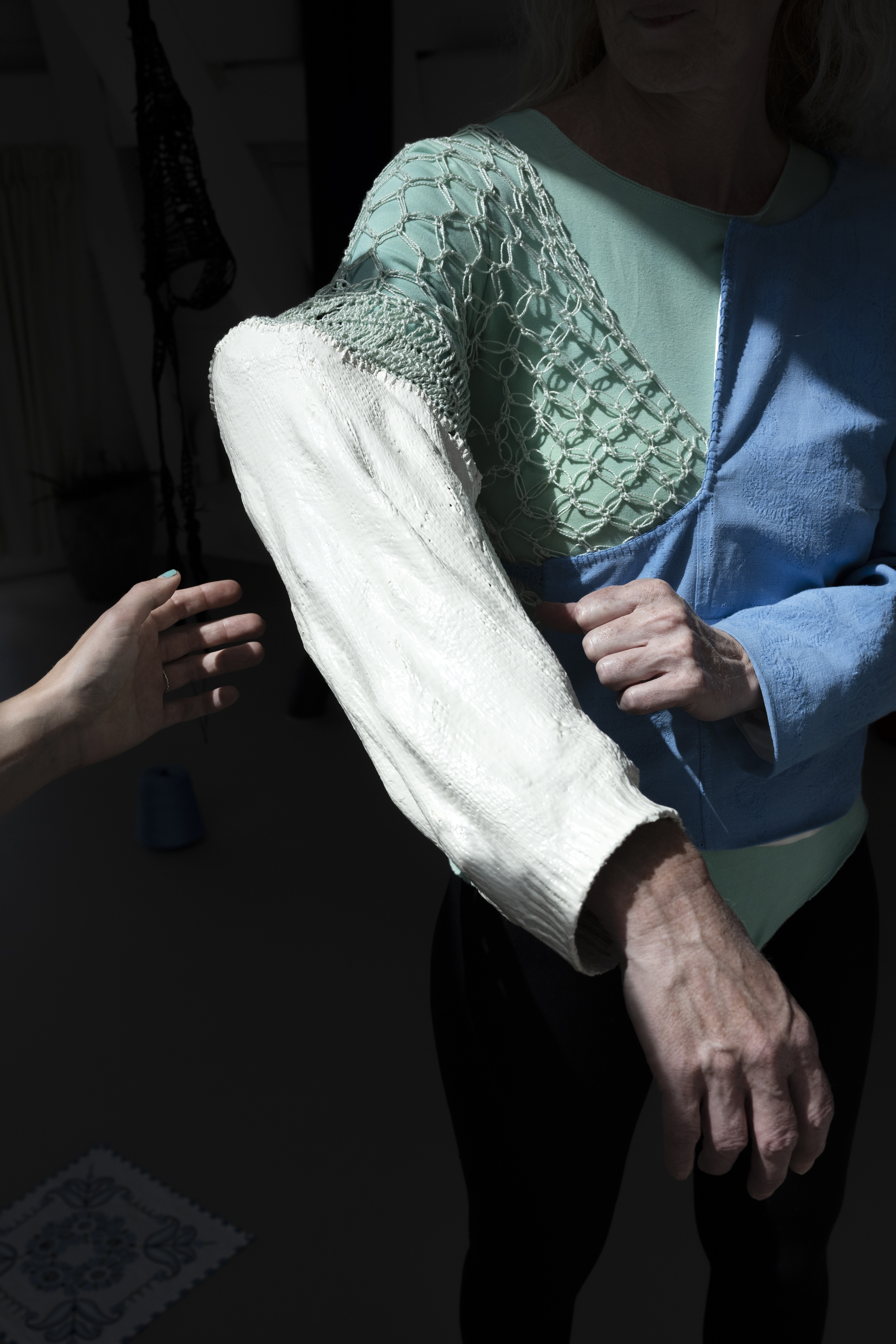
The series ‘Material Echoes-Is this water’ is part of my ongoing research into ambiguous materials. By translating the tactile, visual and emotional qualities of one medium into another, it explores the poetic tension between contrasting materials, in this case ceramic and textile. Each piece forms a translation and interpretation, focusing on ambiguity, material transformation, and sensory deception. The material functions as a translator: using the crafting process as a medium not just for reproduction but for reinterpretation and to create tactile narratives.
As the 6th Resident of the Fonds for Young Design Programm of Stiftung Hamburger Kunstsammlungen I was invited to develop a new work and exhibition for MK&G Hamburg.
The exhibition Forget Me Not and the purchase of a whole body of work by Stiftung Hamburger Kunstsammlungen for the MK&G collection marks a milestone within my artistic practice. I am very grateful for the opportunity.
TOO SILENT,
TOO LONG
Too Silent, Too Long is an ongoing project and a body of crocheted works that move from implicit expression to direct political engagement. I once avoided text in my work, fearing it would constrain interpretation or overpower nuance. But reflecting on my works so far, I’ve come to realize that my work is political, and that in times like this needs to be somewhat explicit. Silence, especially in today’s world, is not neutral— and it is a privilege we cannot afford.
I SEE YOU,
SEEING ME
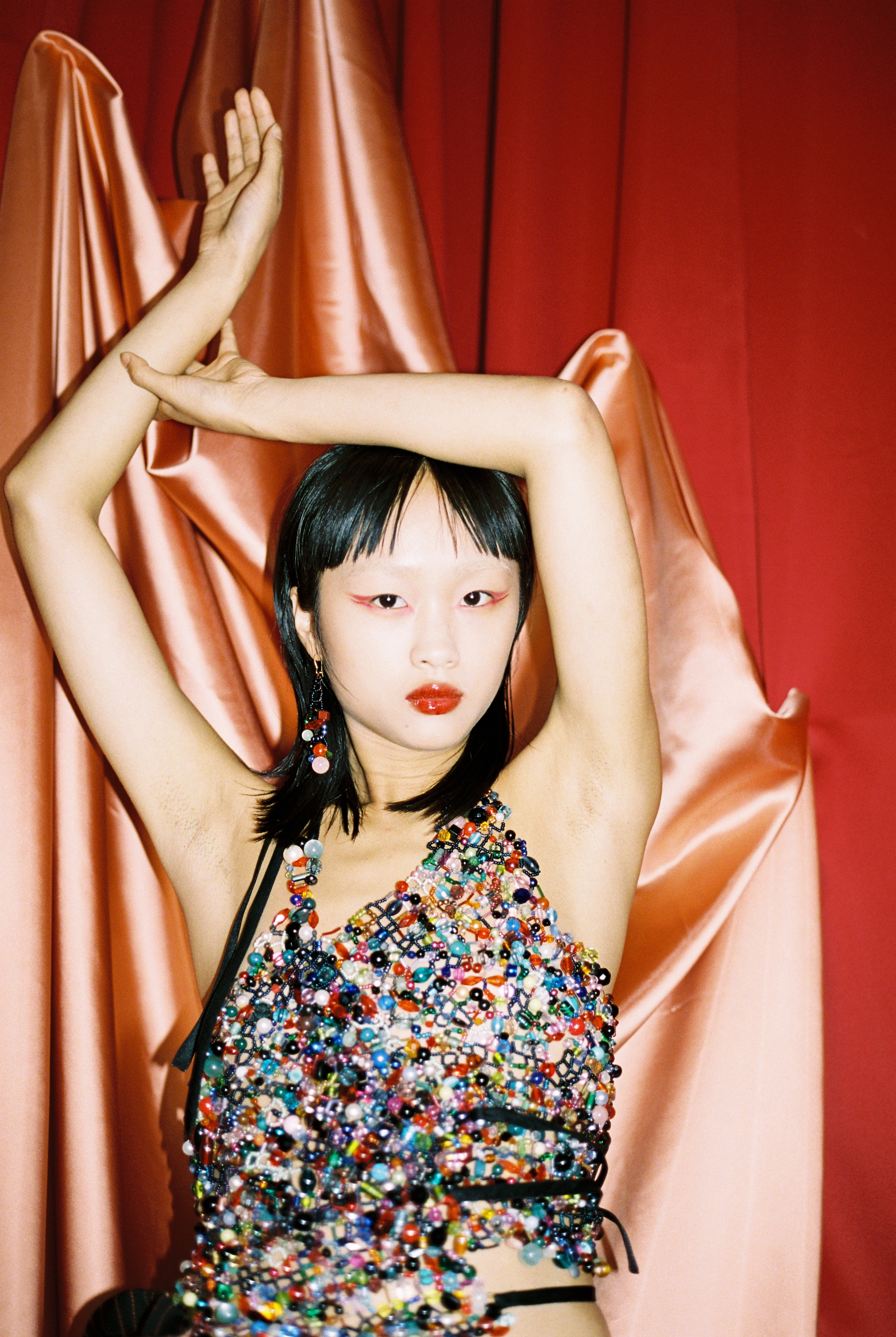
See You Seeing Me is a collaboration between poet Manka Menga and textile artist Katharina Spitz. The work unfolds through a constellation of materials and expressions: two embroidered Khangas, a crying dress crocheted from human hair and adorned with glass beads, a delicate hair-veil, a soundscape interwoven with spoken word and a lament by Sofie Schietekatte, and a gestural performance that binds it all together.
Within my graduation collection I researched play as a critical perspective on contemporary fashion and artistic practice. And thus questioned the strained relation between work and play in modern western society.
IN THE FACE OF LOSS
“In the Face of Loss”, 2019, was triggered by the story of a tablecloth that found its way into my hands.
Itstarted with the encounter of a crafting woman [me] and an object [1950s hand-embroidered army-navy tablecloth]. It includes research, sculptural garments, text and photography by Bram Petraeus.
ANOTHER MYTH OF ETHERNAL SAMENESS
If eternal sameness doesn't guarantee eternal closeness, than what hope could there possibly be for siblings, parents or lovers?The research of twin-narratives shows: they are trying to construct a myth. A myth of eternal sameness, which I state is a cultural snag because it is a contradiction to the way we, in contemporary western society, experience and think about selfhood. Corporate uniform is aiming to create the same kind of false myth, tries to create another myth of eternal sameness.
MATERIAL ECHOES
Soft Stones (weave)
For Soft Stones I was searching for textile means to translate these ambiguities back into textile at the Textile Museum in Tilburg on industrial jacquard-weaving and knitting machines. Throughout the process we searched to translate the ambiguities inherent in that ceramic object back into the textile surface. Apart from the visual dimensions, we aimed to translate the material properties of the hard, shiny and resilient ceramic into the textile and aimed for depth, volume and structure that were apparent in the piece we took as inspiration.
Soft Stones – WEAVE (2024)
Series of works: Material Echoes - Soft Stones Materials: Merino Wool,
Dimensions: 124x164cm
Realised at Textile Museum Tilburg
WE TOO WILL PASS – CERAMICS NO.16 (2024)
Series of works: Material Echoes - Soft Stones Materials: Materials: glazes ceramics, handmolded
Dimensions: 16x13x6cm
Is this water
For Is this water I was searching for textile means to translate these ambiguities back into textile at the Textile Museum in Tilburg on industrial jacquard-weaving and knitting machines. Throughout the process we searched to translate the ambiguities inherent in that ceramic object back into the textile surface. Apart from the visual dimensions, we aimed to translate the material properties of the hard, shiny and resilient ceramic into the textile and aimed for depth, volume and structure that were apparent in the piece we took as inspiration.
IS THIS WATER #2 (2025)
Series of works: Material Echoes - Is this water
Dimensions: 167 x 40 cm Materials: various yarns
Realised at Textile Museum Tilburg
IS THIS WATER #3 (2025)
Series of works: Material Echoes - Is this water
Dimensions: 152 x 45 cm Materials: various yarns
Realised at Textile Museum Tilburg
IS THIS WATER #1 (2025)
Series of works: Material Echoes - Is this water
Dimensions: 165 x 47 cm Materials: various yarns
Realised at Textile Museum Tilburg
Soft stones (knit)
Soft Stones – KNIT (2024)
Series of works: Material Echoes - Soft Stones Materials: Merino Wool,
Dimensions: 168x128cm
Realised at Textile Museum Tilburg
The series ‘Material Echoes is part of an ongoing research into ambiguous materials.
By translating the tactile, visual and emotional qualities of one medium into another, it explores
the poetic tension between contrasting materials, in this case ceramic and textile. Each piece
forms a translation and interpretation, focusing on ambiguity, material transformation, and sensory
deception. The project investigates the tension of how softness can appear rigid, how solidity can mimic
fluidity, and how visual structure can suggest weight, texture, and dimensionality across material
boundaries.
TOO SILENT, TOO LONG
We too will pass, so how do we want to be remembered?
Too Silent, Too Long is an ongoing project and a body of crocheted works that move from implicit expression to direct political engagement. I once avoided text in my work, fearing it would constrain interpretation or overpower nuance. But reflecting on my works so far, I’ve come to realize that my work is political, and that in times like this needs to be somewhat explicit. Silence, especially in today’s world, is not neutral— and it is a privilege we cannot afford.
We too will pass so how do we want to be remembered (2023),
crocheted and embroidered wallhanging,
... cm
(Property of Stiftung Hamburger Kunstsammlungen)
Lächel doch mal
Through crochet, I engage in a slow, deliberate form of resistance—asserting the value of female craftsmanship while creating space for contemplation and care. Each piece carries statements that are clear but poetic, formed and stitched in time by urgency. Unlike social media, which often demands certainty and punishes vulnerability, this process allows me to question, to reflect, and to grow.
Dein blaues Herz ist mir nicht groß genug,
The works are multilingual because protest is culturally and contextually shaped and determined—language carries position, and every act of resistance arises from a specific time and place. Living as a German in the Netherlands, I often feel the tension of being between languages: competent but not instinctive, emotionally distanced, yet acutely aware of nuances others may miss. Coming from personal experience rather than a moral high ground this position sharpens my sensitivity to how structural biases—especially those against women—are subtly encoded in everyday language and behavior. Too Silent, Too Long is both a personal and political response to that realization: a reclaiming of voice through craft, and a call for thoughtful, embodied protest.
Dein blaues Herz ist mir nicht groß genug,
crocheted and embroidered wallhanging,
cotton yarn and beads on recycled plexiglas
98x80 cm
(available)
I SEE YOU SEEING ME
I SEE YOU
SEEING ME


I See You Seeing Me
in collaboration with Manka Menga.
See You Seeing Me is a collaboration between poet Manka Menga and textile artist Katharina Spitz. The work unfolds through a constellation of materials and expressions: two embroidered Khangas, a crying dress crocheted from human hair and adorned with glass beads, a delicate hair-veil, a soundscape interwoven with spoken word and a lament by Sofie Schietekatte, and a gestural performance that binds it all together.
Through these intertwined forms, the artists explore themes of womanhood, social cohesion, and memory. The performative work merges object, word, and embodiment, creating a living dialogue between material and voice, silence and gesture.
What unites Menga and Spitz is a shared longing—rooted in a critical yet open view of time, space, and society. Their practice is poetic, critical, and unflinchingly honest. While Menga distills experience into language, Spitz translates societal conflicts into the tangible world of fabric, thread, and texture.
Together, they have created a threefold work that illuminates shared experiences and a collective yearning for connection, belonging, and communal transformation. See You Seeing Me becomes both a mirror and a meeting place—where vulnerability and strength coexist, and where art itself becomes an act of seeing, and being seen.
‘The emotional journey continued with “I SEE YOU SEE ME,” a collaborative piece by designer Katharina Spitz and poet Manka Menga. The duo courageously explored themes of womanhood, ritualistic desires, and the embodiment of space and time, deeply inspired by resilient women who have carved out their legacy in both history and society’s consciousness.’ - Kaltblut magazine
Photography: Ruben Hilkens for Fashionclash FestivalSound: Sophie SchiettekatteFunded by: Amarte Fonds and Fashionclash Festival
Forget Me Not


The exhibition Forget Me Not and the purchase of a whole body of work by Stiftung Hamburger Kunstsammlungen for the MK&G collection marks a milestone within my artistic practice. I am very grateful for the opportunity.
In the exhibition “Forget Me Not” at the MK&G, the designer explores varied forms of memory culture – ranging from monuments to personal symbolic trinkets to dynamic textile objects – to question why and how we choose to hold onto certain memories. She makes the ambivalences inherent in the forms taken by such tokens of remembrance visible by combining opposing fabric properties and thus creating an ambiguous materiality: Ceramic imprints of body parts recalling the striving for immortality embodied by antique marble busts are encased in finely spun thread; crocheted textiles and flowing wool fabrics propose an abstract alternative to the “knot in the handkerchief”; and delicate forget-me-not embroidery is nearly absorbed by black velvet. “I plead for a mobile, social form of memory that embraces impermanence, as opposed to a society that tries to manifest itself as eternal through its commemorative objects, resisting the passage of time and mortality,” the designer explains. In addition to newly created works, the exhibition also features objects from the MK&G collection, including for the first time the series “Mein Denkmal” (My Memorial) by photographer Bettina Flitner (b. 1961) as well as fashion photographs by F.C. Gundlach (1926–2021), a four-faced wooden head as a memento mori (c. 1650), and intricately woven objects made of human hair (Hamburg, c. 1800–1850) as personal mementos of the deceased.
Collection

Memory cultures show us how societies represent themselves and how they want to be remembered. Forget Me Not asks with which intention and what sort of objects a culture shapes its own memory and legacy. The body of work consists of textile works with unusual material properties: ceramic body parts that appear to be knitted, crochet textiles and softly knitted wool fabrics. ‘Forget Me Not’ reveals differences between how objects cultivate our memory. There are, for example, personal objects, like a knotted hair brooch to commemorate a loved one. But also objects that express the memory cultures of societies that try to overcome their own mortality through static self-representation. This tension is used by Spitz as a starting point for her own fashion designs, in which she explores the possibility of a transformative memory culture. Transience should, according to Spitz, no longer be conceived of a threat. She invites us to reflect upon existing memory cultures from a feminist and material-oriented perspective.
Fragments of the thoughtprocess from the designer about ‘Forget Me Not’:
(Hamburg, 2023)
(Hamburg, 2023)
‘What shape do we give to our memory objects? With what intention and what implications? What does the materiality of our memory culture tell about us human beings at a specific moment in time and space? How does our memory look like in the past, present and future? How can we impact the way it feels, smells or behaves?’

‘An ‘empire’ wants to carve its ideal image in stone and to resist the constant threat of decay. The equestrian statue is static, militaristic and, in practice, often male. An empire and its objects scream in my face. Remember me exactly like this – forever. But above all it, the ‘empire’ culture of remembrance, acts, as if it could stage and manifest itself as eternal. Ich bin die Ewigkeit. I am eternity. I do understand this desire and striving for eternity well. And I understand the desire to carve myself in stone. Because then I will be remembered. Have control over my legacy. For a long time.


‘Imagine a picture of hair, a knot in your handkerchief or trimmings on your belt. And imagine, in contrast, an ideal body carved in marble, or equestrian statue. Both are ways in which we explicitly give form to our memory and use a particular materiality and symbolism.’

‘But my stitches are fragile, my stitches are impermanent and at the same time they are mobile, moving with time, able to acknowledge impermanence. A culture of remembrance that manages to put a broken thing back together. That would be a good culture of remembrance that manages to create something new that is linked with the old and at the same time creates something genuinely new. ‘


‘The ‘empire’ type of memory object is static and will break because it cannot move with time. But of course it will stay in the world longer than, for example, textiles. But it fails to acknowledge that it will eventually break. And it will break for sure. And then it can no longer follow the movement of time. Then it falls out of time, falls from the world.’

‘Forget Me Not reveals another aspect. Our will to manifest as eternal communicates to our fellow human beings. So the ‘empire’ idea of remembering reveals a notion of manifestation of status in the present.’
Bigger than life, bigger than anything.

‘I am imagining a more textile, flexible shape of memory. Is the form in which we remember and want to be remembered unchangeable? Is our memory formally and symbolically carved in stone to create an ideal image against time? Or is there the possibility of re-composing our forms of remembering, in the literal sense of the word [re]member?’

The desire is human and present. But it is also aggressive. I am not comfortable with this. I don’t want this.’

‘Marble, stone, hard, cold - these characteristics have a huge tension with everything that I otherwise find thematically or formally inspiring. It was exactly this moment of tension that I hoped for. From a tension like that, I can work.’
![]()
‘What is considered a monument? What is the purpose of a monument or memorial? How about the representation of people in our public spaces who are not white and male? And what are the bodies we depict?’
![]()
‘My time is a different time and my society is a society in which there are not only militaristic white men on horses. My time is a threatened time, threatened like any other time - by decay. Maybe my time is confronted with this fragility and threat of decay more and sooner. Our world is falling apart.’
![]()
![]()
‘On this same page we find the reason for the fetishization of youth in contemporary fashion. We do not want to see old bodies, as we don’t want to be confronted with this constant thread of decay. So we fetishize youth and youthful bodies - and call it fashion. I call it agesim.’

‘What is considered a monument? What is the purpose of a monument or memorial? How about the representation of people in our public spaces who are not white and male? And what are the bodies we depict?’

‘My time is a different time and my society is a society in which there are not only militaristic white men on horses. My time is a threatened time, threatened like any other time - by decay. Maybe my time is confronted with this fragility and threat of decay more and sooner. Our world is falling apart.’


‘On this same page we find the reason for the fetishization of youth in contemporary fashion. We do not want to see old bodies, as we don’t want to be confronted with this constant thread of decay. So we fetishize youth and youthful bodies - and call it fashion. I call it agesim.’
‘Looking at fashion and its striving to manifest itself as eternal makes this great tension most exiting! Because of the great paradox between fashion and eternity. Isn’t fashion actually like constant change? Or should we believe the great fashion empires that do try to stage themselves as eternal? Let’s remember the dialogue between fashion and death (Giacomo Leopardi, 1824), let’s think of fashion theories that clearly show that fashion, as a system and favorite child of capitalism (Werner Sombart, 1902), is constantly fueling itself more and more so it has to change ever faster. We live this kind of fashion for a variety of economic, psychological and sociological reasons. One of them, I believe, is that we always want the younger, newer and fresher because at the end of the day we don’t want to be confronted with the inevitable decay of everything. We refuse to acknowledge impermanence because, ultimately, we don’t want to confront our own mortality.’
Fragments of the thoughtprocess from Katharina Spitz
(Hamburg, 2023)
(Hamburg, 2023)
Forget Me Not
Exhibition

Memory cultures show us how societies represent themselves and how they want to be remembered. Katharina Spitz asks with which intention and what sort of objects a culture shapes its own memory and legacy. On show are textile works with unusual material properties: ceramic body parts that appear to be knitted, crochet textiles and softly knitted wool fabrics.


‘Forget Me Not’ reveals differences between how objects cultivate our memory. There are, for example, personal objects, like a knotted hair brooch to commemorate a loved one. But also objects that express the memory cultures of societies that try to overcome their own mortality through static self-representation. This tension is used by Spitz as a starting point for her own fashion designs, in which she explores the possibility of a transformative memory culture. Transience should, according to Spitz, no longer be conceived of a threat. She invites us to reflect upon existing memory cultures from a feminist and material-oriented perspective.
As part of my six month residency at the MK&G in Hamburg I was asked to develop a new work and exhibition for the Museum and ultimately the museum collection, on the basis of my experience of the latter.
I chose to curate an exhibition with objects from (almost) every collection the museum offers as a context to my new body of work Forget Me Not. The objects I curated with my new work show the tension I was designing from. I am grateful, among others, for the works by Hans Hansen, Rei Kawakubo, Yves Saint Laurent, F. C. Gundlach, Schiaparelli, Doerte Eissfeldt and especially Bettina Flitner. Her series 'My Monument' touched me deeply and triggered me to set off on the path leading to 'Forget Me Not'.
Building my exhibition and rooting my new work in the context of these amazing works has been an honor.

Forget Me Not
PROCESS
All Images by Alisa Reutova
Copyright / Concept / Design / Crafting Katharina Spitz
Talents: Kadija Cham, Elisa Sophie Wedmann, Lene Wittkamp, Amelie Frischbier
Agencies: Modelwerk, SPIN Modelmanagement
PLAY HARDER
is all about play.
Within my graduation collection I researched play as a critical perspective on contemporary fashion and artistic practice. And thus questioned the strained relation between work and play in modern western society.
I implemented my findings into practice within a process that was characterised by playful interventions. Understanding fashion as a playful situated practise brings it back to the essence of what it could be:
relation with each other, relation to our surroundings and a strategy to reappropriate our environments.
This offers a strategy against distance in production and against usability and productivity claims, so overtly present in our times.
We played.
In this playful process a series of ornamental objects were created
- very unpractical and useles
but extremely functional for playful interaction. -
With these objects we can create and recreate our communal expression in play over and over again. The photographs at hand show three different stories of how different communal expression can arise in play.
The development of this playful process as a critical tool against production and process that is given shape solely according to economic standarts resultet in a project that makes one plea very obvious:
Dear Craftswo:men and Designers,
Der Fashionlovers and People who dress:
Let’s try to play harder!
Der Fashionlovers and People who dress:
Let’s try to play harder!
Editorial_1
is all about play.
Photography: Angelina Vernetti
Make-Up: Titia Grefe
Model: Mia Raz, Frederik Britzlmair
Make-Up: Titia Grefe
Model: Mia Raz, Frederik Britzlmair
Another Story
This story is based on Johanna Braun’s perception of the objects created in the „Play Harder“ Graduation collection. This story tells one of the stories we can create with the „Play Harder“ garments.
![]()
This story is based on Johanna Braun’s perception of the objects created in the „Play Harder“ Graduation collection. This story tells one of the stories we can create with the „Play Harder“ garments.
A sensitive, tender and very strong story, captured in all its strength through the lense of Lexi Sun. This story is one of many stories we can tell.
In play we can create
and re-create.
and re-create.
The anonymous place of a functional home was transformed by a playful interaction with each other, the garments and the space. In play my anonymous home has become our playground and thus transformed into a protected space. Not afraid. Personal. In this intimate setting, the garments do not appear as loaded-with-ideology- items for external display. They become sensitive, personal attributes.
Photography: Lexi Sun, Styling: Johanna Braun and Katharina Spitz, Make-Up: Una Ryu,
Design/Crafting: Katharina Spitz
Model: Jee Hye Lee @izaio.modelmanagement, @izaiodevelopment
Photography: Lexi Sun, Styling: Johanna Braun and Katharina Spitz, Make-Up: Una Ryu,
Design/Crafting: Katharina Spitz
Model: Jee Hye Lee @izaio.modelmanagement, @izaiodevelopment
Photography: Lexi Sun, Styling: Johanna Braun and Katharina Spitz, Make-Up: Una Ryu,
Design/Crafting: Katharina Spitz
Model: Jee Hye Lee @izaio.modelmanagement, @izaiodevelopment
The Playmoment

Photography: Angelina Vernetti
Performers: Mia Raz, Frederik Britzlmair, Naja Stellmach, Phillip Kind, Laura Talkenberg, Elizaveta Efimova
In the Face of Loss
“In the Face of Loss”, 2019, was triggered by the story of a tablecloth that found its way into my hands.
It started with the encounter of a crafting woman [me] and an object [1950s hand-embroidered army-navy tablecloth]. It includes research, sculptural garments, text and photography by Bram Petraeus.
The tablecloth told a story about mortality, womanhood and crafting, that from a feminist perspective counters a more common story in which female makers' traditions and flower-symbolism are reduced to biological reproduction.
The cloth contains paradoxes between technology and symbolism, that made me aware of the potential for cultural reproduction through making.
Crafting is a ritual act aiming at something permanent in a world threatened by decay and death. The floral symbolism makes this paradox tangible. The woman as a sister is the material agent of cultural reproduction. She enables relation to space and time through her crafting and the objects she makes.
Crafting transforms the makers presence into an object, that becomes a repository of the makers presence. Such objects are contagious and spread their power and aura to things and people around it.
Possession creates difference, so does female crafting. The acknowledgement of female power through crafting proofs the ritual making as an empowering act. She is preserving and conserving what is inevitably dying.
The emancipated crocheted flower-patterns are fraying, decaying and waxed against this constant threat.
The knitted/clayed objects are embodying fragility and permanence. The composition of artworks show the paradoxes raised by the tablecloth's story and portrait the woman as a sister who is creating objects of permanence in a world threatened by death and decay.
The tablecloths story calls for a feminist movement in the arts and crafts. With its focus on aesthetic, sensual perception. About value and time, value through time
and power through crafting.
It started with the encounter of a crafting woman [me] and an object [1950s hand-embroidered army-navy tablecloth]. It includes research, sculptural garments, text and photography by Bram Petraeus.
The tablecloth told a story about mortality, womanhood and crafting, that from a feminist perspective counters a more common story in which female makers' traditions and flower-symbolism are reduced to biological reproduction.
The cloth contains paradoxes between technology and symbolism, that made me aware of the potential for cultural reproduction through making.
Crafting is a ritual act aiming at something permanent in a world threatened by decay and death. The floral symbolism makes this paradox tangible. The woman as a sister is the material agent of cultural reproduction. She enables relation to space and time through her crafting and the objects she makes.
Crafting transforms the makers presence into an object, that becomes a repository of the makers presence. Such objects are contagious and spread their power and aura to things and people around it.
Possession creates difference, so does female crafting. The acknowledgement of female power through crafting proofs the ritual making as an empowering act. She is preserving and conserving what is inevitably dying.
The emancipated crocheted flower-patterns are fraying, decaying and waxed against this constant threat.
The knitted/clayed objects are embodying fragility and permanence. The composition of artworks show the paradoxes raised by the tablecloth's story and portrait the woman as a sister who is creating objects of permanence in a world threatened by death and decay.
The tablecloths story calls for a feminist movement in the arts and crafts. With its focus on aesthetic, sensual perception. About value and time, value through time
and power through crafting.


Another Myth
of
Eternal Sameness
If eternal sameness doesn't guarantee eternal closeness, than what hope could there possibly be for siblings, parents or lovers?
The research of twin-narratives shows: they are trying to construct a myth. A myth of eternal sameness, which I state is a cultural snag because it is a contradiction to the way we, in contemporary western society, experience and think about selfhood. Corporate uniform is aiming to create the same kind of false myth, tries to create another myth of eternal sameness.

Photography: Angelina Vernetti
Make-Up: Jasmin Erb
Model: Mia Raz, Sarah Sekles, Rayssa M. Regis
Make-Up: Jasmin Erb
Model: Mia Raz, Sarah Sekles, Rayssa M. Regis
TAILORING
Traditional tailoring is held in high regard at Studio Katharina Spitz. That is why we offer various tailoring services.
Whether it's occasional or wedding dresses, your worn out item repaired or revived, alterations or made-to-measure.
Each service is individually designed and uniquely tailored for every customer.
PRIVATE LESSONS & WORKSHOPS
Haken beginners en intermediate/advanced
Mouleren Basistechnieken
Mixed technique upcycling
Priveles naaien, Haken, tuften
TAILORING SERVICES
Traditional tailoring is held in high regard at Studio Katharina Spitz. That is why we offer various tailoring services.
Whether it's occasional or wedding dresses, your worn out item repaired or revived, alterations or made-to-measure.
Each service is individually designed and uniquely tailored for every customer.
How does it work?
The process always depends on your wishes and differs a little depending on the kind of garment or service you want.
Your bridal dress follows a different process than the designer-sample we make. But key to all our tailoring services and made-to-measure garments is the dedication to craftswomanship and eye for detail.
The process always depends on your wishes and differs a little depending on the kind of garment or service you want.
Your bridal dress follows a different process than the designer-sample we make. But key to all our tailoring services and made-to-measure garments is the dedication to craftswomanship and eye for detail.
FIRST CONSULTATION
To accommodate your wishes, we like to get to know you and your ideas in an individual initial consultation. For this purpose, we invite you to our atelier in Amsterdam. Feel free to bring along any designs or concepts you already have in mind. With our attention to detail, years of experience, and knack for understanding our clients, we'll craft an outfit that's just right for you and the occasion.
FITTINGS
Creating the perfect ensemble is a journey. It's all about you, and we'll work closely with you to perfectionize every detail. Each fitting is a chance for inspiration to strike and for your vision to come to life. There's no rush here; we take our time and pour our dedication into every stitch. Rest assured, we'll guide and advise you every step of the way until we achieve a look that leaves you completely satisfied.
FOR YOUR UNIQUE DESIRES
We are happy to welcome you in our studio/showroom and provide you with further information. Here you can also have a look at our collections for inspiration and try our wearables.
For further information, or to book an appointment feel free to send an e-mail to spitzkatha@gmail.com - we are looking forward to meet you!
To accommodate your wishes, we like to get to know you and your ideas in an individual initial consultation. For this purpose, we invite you to our atelier in Amsterdam. Feel free to bring along any designs or concepts you already have in mind. With our attention to detail, years of experience, and knack for understanding our clients, we'll craft an outfit that's just right for you and the occasion.
FITTINGS
Creating the perfect ensemble is a journey. It's all about you, and we'll work closely with you to perfectionize every detail. Each fitting is a chance for inspiration to strike and for your vision to come to life. There's no rush here; we take our time and pour our dedication into every stitch. Rest assured, we'll guide and advise you every step of the way until we achieve a look that leaves you completely satisfied.
FOR YOUR UNIQUE DESIRES
We are happy to welcome you in our studio/showroom and provide you with further information. Here you can also have a look at our collections for inspiration and try our wearables.
For further information, or to book an appointment feel free to send an e-mail to spitzkatha@gmail.com - we are looking forward to meet you!
COUTURE
INDIVIDUAL
REPAIR
BRIDAL
INDUSTRY PATTERN MAKING, PROTOTYPING AND SAMPLING
CLIENTS
HOUSE OF RUBBER
KNOTT BAGS
SEAN HANNAN
SUSANNA INGLADA
WITTE VAN HULZEN & SANDER BREURE
LAURA DOLS
SWAPSHOP NL
COMMISSIONED WORK
BIG BAG (2024)
pattern making, design, material development, textile crafting.For Nottbags, exhibited in various shops and used as photography-prob
pattern making, print development, construction, textile crafting (various techniques)
for House of Rubber,
exhibited at This Art Fair, Fashionclash and DDW
for House of Rubber,
exhibited at This Art Fair, Fashionclash and DDW
HEAD OF MEDUSA (2022)
pattern making, construction, textile crafting (various techniques)for Susanna Inglada, exhibited at Kunstlinie Almere
costume design
dressmaking, textile crafting, print design
costume design, print development and crafting of embroidered headpiece.
For Sean Hannan’s work ‘LUCK’, exhibited in When things are beings at Stedelijk Museum Amsterdam, November 2022
LADY IN RUG
pattern making, print development, construction, textile crafting (various techniques)
House of Rubbers ‘Lady in Rug’ exhibited at DDW, This Art Fair, KunstRAI
pattern making, print development, construction, tufting, presentation
textile sculpture
BIG BAG
pattern making, design, material development, textile crafting

textile sculpture
design implementation, making of underconstruction and sculpture, various textile techniques
‘Head of Medusa’ for Susanna Inglada, exhibited at Kunstlinie, Almere (2022)

Publications
NDR Hamburg Journal, (starting at min. 6:00) Kulturtipp, 2023
UNFAMOUS Magazine, Paris, Avant-Garde Allure, Issue (2024)
List of Artists: LINK
“Katharina Spitz: Mode einmal ganz anders sehen”, Frank Schreiber, Hamburger Abendblatt, 2023
![]()
The world’s a little blurry,Quality Magazine, [print]
![]()
List of Artists: LINK
“Katharina Spitz: Mode einmal ganz anders sehen”, Frank Schreiber, Hamburger Abendblatt, 2023The world’s a little blurry,Quality Magazine, [print]

Kaltblutmagazine, November 2021
Fashion United, 2021
https://fashionunited.de/nachrichten/mode/udk-berlin-kritisch-denken-und-hinterfragen-im-modedesign-studium/2021102843494
KALTBLUT MAGAZINE, 2021
https://www.kaltblut-magazine.com/udk-schau21-a-review/
1Granary, 2020
https://1granary.com/designers-3/schools/fashion-schools-in-lockdown-berlin-university-of-the-arts/
SLEEK MAG, 2019
https://www.sleek-mag.com/article/ask-berlin-fashion-students/
https://fashionunited.de/nachrichten/mode/udk-berlin-kritisch-denken-und-hinterfragen-im-modedesign-studium/2021102843494
KALTBLUT MAGAZINE, 2021
https://www.kaltblut-magazine.com/udk-schau21-a-review/
1Granary, 2020
https://1granary.com/designers-3/schools/fashion-schools-in-lockdown-berlin-university-of-the-arts/
SLEEK MAG, 2019
https://www.sleek-mag.com/article/ask-berlin-fashion-students/
Interview with Lucy Rowan
‘Play Harder’
OE Magazine, Oktober, 2021
“I am fascinated by phenomena that shape our social networks and ultimately, our position in space and time. So I guess my main inspirations are sociological phenomena as well as crafting techniques and the materialities I am working with. I am seeking ways in which my designs, performances and dressmaking can open up new perspectives of being in a world that is suffering from pollution, inequality and alienation.”
READ THE FULL INTERVIEW
Publications
Editorial
‘The Chop’
Schön!magazin, Juni 2021
Editorial
The Chop, online editorial shot by photographer Lotte Thor invites us
to explore movement, creativity,
fashion and more. Model Maya Dejean
wears looks from Y/Project, Jacquemus, Kwaidan Editions and others styled
by Silke Holzschuher. Hair for the editorial is by Sutida and make up
is by Naomzz.
to explore movement, creativity,
fashion and more. Model Maya Dejean
wears looks from Y/Project, Jacquemus, Kwaidan Editions and others styled
by Silke Holzschuher. Hair for the editorial is by Sutida and make up
is by Naomzz.
Editorial
[PRINT]
‘The World’s a little blurry’,
Photographer: Arnaud
Ele @arnaud.ele
@cosmopola_berlin
Creative
production: Laura
Knoops @knoops
Styling:Danny
Muster Works @dannymusterwork assisted
by:Ann-Kathrin Schröder @loamauna
Muah:Susanna
Helen @susanna_helen_
Model: Maxie
Elizabeth@maxie_elizabeth
Mint
Artist Management @mintartistmanagement
Video:Noé
Cassi @noedelanuit
Executive
production: Eleknoop @eleknoops
Photographer: Arnaud
Ele @arnaud.ele
@cosmopola_berlin
Creative
production: Laura
Knoops @knoops
Styling:Danny
Muster Works @dannymusterwork assisted
by:Ann-Kathrin Schröder @loamauna
Muah:Susanna
Helen @susanna_helen_
Model: Maxie
Elizabeth@maxie_elizabeth
Mint
Artist Management @mintartistmanagement
Video:Noé
Cassi @noedelanuit
Executive
production: Eleknoop @eleknoops
Bra
& pants: Katharina Spitz
Hat:
Anne Bellinger / Joy Weinberger
Furry
arm: Esther Perband
Dress:
Esther Perbandt
Hat:
Fiona Bennett
Earrings:
Ottolinger
Photography: Alisa Reutova
Talents: Amelie Frischbier, Kadija Cham, Lene Wittkamp, Elisa Sophie Wedmann
Make Up: Thalea Bisschop
Talents: Amelie Frischbier, Kadija Cham, Lene Wittkamp, Elisa Sophie Wedmann
Make Up: Thalea Bisschop
LOOK
BOOK
LOOK
BOOK
Photography: Angelina Vernetti
Make-Up: Titia Grefe
Model: Mia Raz, Frederik Britzlmair
Make-Up: Titia Grefe
Model: Mia Raz, Frederik Britzlmair

Photography: Angelina Vernetti
Make-Up: Jasmin Erb
Model: Mia Raz, Sarah Sekles, Rayssa M. Regis
Make-Up: Jasmin Erb
Model: Mia Raz, Sarah Sekles, Rayssa M. Regis
Photography: Bram Petraeus
Model: Marianne van Versendaal
About
Katharina Spitz
I am Katharina Spitz, an Amsterdam-based textile artist, designer and tailor with a passion for meticulous craftsmanship and the societal tensions woven into textiles.
As the founder of a textile and tailoring studio, I work across textile art, performance and costume — blending traditional tailoring with experimental techniques and material research like hairworks, textile sculpture, ceramics, tufting, and crocheting.
I create garments, performances and sculptures that explore material, form, and meaning — one thread at a time.
As the founder of a textile and tailoring studio, I work across textile art, performance and costume — blending traditional tailoring with experimental techniques and material research like hairworks, textile sculpture, ceramics, tufting, and crocheting.
I create garments, performances and sculptures that explore material, form, and meaning — one thread at a time.

BIO
Katharina Spitz (b. 1993) is an Amsterdam-based textile artist with a background in couture tailoring. Her practice balances craft, research, and art, exploring new perspectives on pressing social issues through a feminist and material-oriented lens. Using sculpture, performance and textile as her primary mediums, she investigates themes such as inequality, alienation, and identity in poetic, tactile ways.
Spitz's work spans performance, costume design, and sculpture, often created in close collaboration with artists from different disciplines. Recent projects include a performance with a Tanzanian poet, costume design for a dance film by Emma Evelein, and a textile sculpture for visual artist Susanna Inglada. She is also engaged in a project addressing age discrimination in fashion.
Her work has been exhibited at institutions such as the Bundeskunsthalle (Bonn), Marres (Maastricht), Museum für Kunst und Gewerbe (Hamburg), Fashionclash Festival (Maastricht), and Haus der Kulturen der Welt (Berlin). In addition to her artistic practice, she regularly facilitates workshops, where she promotes sustainability, textile skills, and self-empowerment through textile making.
Spitz's work spans performance, costume design, and sculpture, often created in close collaboration with artists from different disciplines. Recent projects include a performance with a Tanzanian poet, costume design for a dance film by Emma Evelein, and a textile sculpture for visual artist Susanna Inglada. She is also engaged in a project addressing age discrimination in fashion.
Her work has been exhibited at institutions such as the Bundeskunsthalle (Bonn), Marres (Maastricht), Museum für Kunst und Gewerbe (Hamburg), Fashionclash Festival (Maastricht), and Haus der Kulturen der Welt (Berlin). In addition to her artistic practice, she regularly facilitates workshops, where she promotes sustainability, textile skills, and self-empowerment through textile making.
EXHIBITIONS / RESIDENCIES
2025
2024
2023
2022
2021
2019
- 31.10.-02.11.2025 Vrijpaleis OPEN, Vrijpaleis (Amsterdam)
group exhibition
- 30.05.–30.07.2025
Kunstgewerbemuseum, Staatliche Kunstsammlungen (Dresden)
‘FÜR ALLE! Demokratie neu gestalten’
group exhibition - 05.04.–01.05.2025
Textilmuseum (Tilburg)
‘Common Ground’
group exhibition
2024
- 11.2024
Fotogenia (Mexico City)
‘Forget Me Not’
filmfestival - 15.–17.11.2024
Marres (Maastricht)
‘I see you seeing me’, funded by AMARTE
performance and exhibition - 15.–17.11.2024
Bureau Europa (Maastricht)
‘New Fashion Narratives’
group exhibition - 10.2024–12.2024
Textielmuseum (Tilburg)
Advanced Textile Programme
residency - 30.05.2024–13.10.2024
Bundeskunsthalle (Bonn, Germany)
‘FÜR ALLE! Demokratie neu gestalten’
group exhibition - 04.2024–11.2024
Fashionclash (Maastricht)
‘New Fashion Narratives’
curatorial residency - 02.2024–05.2024
Big Gallery XS (Delft)
Studio Katharina Spitz and Maartje van den Noort
group exhibition - 26.10.2024–01.02.2024
Museum für Kunst und Gewerbe MK&G (Hamburg, Germany)
‘Forget Me Not’
solo exhibition
2023
- 04.2023–10.2023
Museum für Kunst und Gewerbe MK&G (Hamburg, Germany)
‘Fonds for Young Design’, funded by Stiftung Hamburger Kunstsammlungen
residency - 26.10.2023
Fashionclash Festival (Maastricht)
‘Play Harder’
performance
2022
- 04.05.2022–18.05.2022
Sissy Expo (Amsterdam)
‘In the Face of Loss’
group exhibition
2021
- 30.10.2021
Konzertsaal UdK (Berlin)
‘Freeloading’
graduation show
2019
- 15.09.2019
Haus der Kulturen der Welt HKW (Berlin)
‘Bootcamp Humans Only’
performance - 10.09.2019–15.09.2019
Robert-Koch-Forum (Berlin)
‘Utopias of digital Physicality’
group exhibition - 18.05.2019–20.05.2019
Algomech Festival (Sheffield, UK)
‘Rituals of Care’
group exhibition

VITA

today
- 11/2021 – today
Studio Katharina Spitz — textile artist, designer and tailor - 05/2024 – today
various clients — tailoring and patternmaking - 07/2022 – today
teaching in textiles and sustainability — sewing, patternmaking, workshops, repaircafe - 01/2022 – today
Marlou Breuls / House of Rubber — freelance designer, tailor and studio management
- 03–10/2025
Susanna Inglada — artisan trajectory made possible by Mondriaan Fonds
- 01–03/2025
Emma Evelien — tailoring and costume design for dance film ‘born into you’
- 10/2022 – 01/2023
Susanna Inglada — technical advise and design implementation textile sculpture ‘Head of Medusa’, presented as part of ‘Patretraits’, Kunstlinie (Almere)
- 09/2022 – 11/2022
Sean Hannan — costume design and tailoring for work ‘LUCK’, presented as part of ‘When things are beings’, Stedelijkmuseum (Amsterdam)
- 02/2019
Götze (Berlin) — freelance tailor - 01/2019 – 10/2021
Universität der Künste (Berlin) — junior teacher tailoring and textile techniques
- 10/2017 – 10/2021
University of the Arts (Berlin), Institute for experimental textile and fashion design
BA of Arts Fashion and Textile Design
- 04/2017 – 09/2017
De Nationale Opera (Amsterdam) — freelance tailor soloists costumes
- 08/2016 – 04/2017
Witte van Hulzen & Sander Breure, Rijksakademie (Amsterdam) — textile set design and realisation for film screening
- 03/2014 – 12/202015
Obono (Düsseldorf) — freelance tailor
- 07/2013 – 09/2017
Pio O’kan Couture (Düsseldorf) — bespoke tailor, high-end womenswear
EDUCATION
- 10/2017 – 10/2021
University of the Arts (Berlin), Institute for experimental textile and fashion design
BA of Arts Fashion and Textile Design
- 09/2020 – 02/2021
Marlou Breuls Creative Studio (Amsterdam)
fashion design
- 07/2013 – 06/2016
Pio O’kan Couture (Düsseldorf)
apprenticeship bespoke tailor, specialisation: high-end womenswear, prize for best exam of the year - 08/2004 – 06/2013
Gymnasium: Marienschule Opladen
A-Levels

CONTACT
spitzkatha@gmail.com
+4915789036558
Studioadress: Surinameplein 35, 1058 GM Amsterdam
+4915789036558
Studioadress: Surinameplein 35, 1058 GM Amsterdam